






At WBENC LIFT, we work with entrepreneurs who are building not just growing businesses—but financially ready, strategically fundable companies. One of the most important—and most misunderstood—parts of that journey is financial readiness.
Moving from day-to-day financial management to CEO-level financial strategy isn’t just about reading reports; it’s about using the numbers to make better decisions, manage risk, and invest with confidence.
Too many business owners treat financial readiness as a milestone to “reach” (clean books, a lender-ready package, a great quarter). In reality, the market rewards repeatable financial decision-making: the ability to turn performance signals into choices about pricing, hiring, inventory, investment, and risk. That capability is what separates a business that is merely growing from one that is bankable, resilient, and strategically fundable.
 Based on what we see across WBENC LIFT participants and high-performing founders, here are five insights for becoming a financially empowered CEO:
- Define what “ready” means for your next 12 months.
Tie readiness to the decisions you need to make (new hire, facility, product launch, acquisition, geographic expansion)—not to a generic checklist. - Lead with patterns, not reports.
Pick 3–5 signals you will review monthly (gross margin by offering, cash conversion cycle, customer concentration, operating leverage) and decide in advance what actions each signal triggers. - Build a finance function that matches your stage.
Keep the CEO seat: delegate preparation (bookkeeping, close process, forecasting) while you own allocation decisions and trade-offs. - Treat capital partners like strategic stakeholders.
Don’t wait for a crisis. Establish a cadence (quarterly check-ins) and share your forward-looking plan—what you’re building, what could break, and what you’re doing about it. - Turn your “capital narrative” into a one-page story.
Be able to answer, clearly: Where is the business going? Why now? What is the use of funds? What are the risks and mitigations? What does repayment look like?
The journey to financial empowerment begins when you move past simply knowing your numbers and start applying them. When financial insight is connected to your broader business strategy, it becomes a tool for building long-term value, growing with intention, and increasing resilience.
The CEO is the architect of the business—not the accountant.
- Business owners often wear many hats, especially early on. As the business grows, progress comes from equipping the right financial partners (CPA, bookkeeper, fractional or full-time CFO) while still owning the decisions that determine direction. The CEO’s job is to decide where capital, time, and focus will create the greatest return.
Revenue is a result; financial patterns are the signal.
- Revenue growth matters—but it doesn’t tell the whole story. Patterns in margins, cash conversion, and balance sheet strength reveal how scalable (and how fragile) a business really is. Seeing those patterns early helps leaders anticipate constraints, evaluate trade-offs, and make decisions that protect growth.
Access to capital is shaped not only by financial performance, but by preparation—and the strength of your relationships. How and when you engage lenders and financial partners can directly influence your options, pricing, and terms.
Be Proactive, Not Reactive
- Seasoned entrepreneurs share a consistent lesson: secure capital before you need it. Building funding options from a position of preparedness—not urgency—creates leverage, improves terms, and expands what’s possible.
Communicate a Clear and Evolving Narrative
- Your financial story is more than the numbers; it explains your strategy, priorities, and growth plan. Be ready to articulate where the business is headed, what the capital is for, and how repayment happens. When financial partners understand your vision, they can structure solutions and advocate for you more effectively.
- The most important shift is this: CEOs stop treating financials as a backward-looking scorecard and start using them as a forward-looking operating system. When that shift happens, confidence rises—not because the numbers are perfect, but because decisions become faster, clearer, and easier to communicate to capital partners.
CEO self-check (use these before your next lender or investor conversation)
- Can I explain last quarter’s performance in three drivers (not ten-line items)?
- Do I know my cash runway and the exact levers that extend it?
- If revenue grows 20%, what breaks first—people, capacity, inventory, working capital?
- What is my Plan A and my Plan B if margins compress or a top customer delays payment?
- Can I articulate the use of funds and repayment path in plain language?
WBENC LIFT would like to acknowledge and thank the following experts for their insights and contributions to this article including:
CEO Catalyst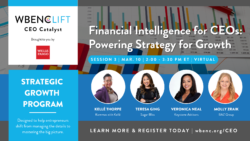 : “Financial Intelligence for CEO’s: Powering Strategy for Growth”
- Kellé Thorpe, Founder & CEO, Kommas with Kellé
- Teresa Ging, Founder & CEO, Sugar Bliss
- Veronica Neal, Founder & CEO, Keystone Advisors
- Molly Zraik, Founder & CEO, BAZ Group

CEO Catalyst and Entrepreneur Financial Readiness: “Design a Funding Readiness Strategy”
- Judith Goldkrand, Strategic Advisor, Vistage
- Helen Lacap, Senior Business Banking Relationship Manager, Wells Fargo
- Kirsten Liston, Founder & CEO, Rethink Compliance
- Brittany Stovall, Founder & CEO, Assured Quality System
- Amy Zitelman, Co-Founder & CEO, Soom Foods
CEO Catalyst and Entrepreneur Financial Readiness are part of the WBENC LIFT Financial Center of Excellence. Learn more today!
