





One of the most common challenges a business owner may face is how to leverage their business success into a strategy for building wealth.
For many entrepreneurs, their business represents their largest asset, primary source of income, and greatest opportunity to create future wealth. Yet business planning and personal financial planning are often approached as separate conversations. This can create significant risks when owners begin thinking about retirement, succession, or an eventual exit.
The businesses that create lasting value are rarely built by accident. They are built through intentional planning, disciplined risk management, and a clear understanding of how business value supports personal financial goals.
 Based on what we see across WBENC LIFT participants and business leaders, here are five insights:
1. Build a Business That Operates Beyond the Owner
- Reduce founder dependency by distributing leadership, decision-making, and daily operations across the organization.
- Document systems, strengthen management teams, and standardize repeatable processes to support growth, succession, and eventual transfer.
2. Define Success as Income, Enterprise Value, or Both
- Decide whether success means generating income, flexibility, and independence—or building an asset that can be sold, transferred, or passed on.
- Recognize that neither path is better, but each requires different priorities and decisions.
- Prioritize cash flow and owner compensation for income-focused businesses; invest in leadership, systems, customer retention, and scalability to increase enterprise value.
- Align decisions with the objective you are pursuing so business strategy supports the desired outcome.
3. Identify the Gaps That Can Impact Your Future
Clarify where you are today, where you want to go, and which gaps could affect long-term business and financial outcomes.
Assess three critical gaps:
- Measure the Wealth Gap: Compare current wealth with the amount needed to support future lifestyle goals.
- Close the Profit Gap: Improve margins, efficiency, and operational performance.
- Narrow the Value Gap: Compare current valuation with potential market value.
Use these insights to prioritize decisions that support business growth and personal financial readiness.
4. Treat Succession Planning as a Business Strategy
- Reframe succession planning as a strategy for continuity, transition, and long-term sustainability—not just retirement or estate planning.
- Prepare the organization to sustain leadership, ownership, and operations through planned transitions.
- Consider the priorities that strengthen succession readiness:
- Develop future leaders
- Evaluate ownership transition options
- Strengthen business continuity planning
- Address family and stakeholder considerations
- Align retirement and wealth planning objectives
- Start early so transitions reflect years of preparation rather than last-minute decisions.
5. Align Business Planning with Personal Wealth Planning
- Connect the value built inside the company to the owner’s personal financial future.
- Determine how much capital should remain in the business for growth and how much should support personal wealth accumulation.
- Coordinate business value, retirement readiness, risk management, and wealth creation to support future financial independence.
- Ensure business success and personal financial success work together rather than compete for resources.
As you think about the future of your business, consider the following questions: (Use these to see if you’re on the right track to building wealth outside of your business)
-
Does my business operate independently of me?
-
Do I understand the current value of my company?
-
Have I identified the leadership needed for future growth?
-
Is there a plan for ownership transition?
-
Will my current strategy support my long-term financial goals?
-
Am I building income, value, or both?
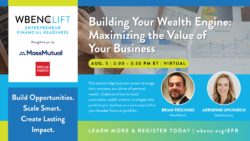 WBENC LIFT would like to acknowledge and thank the following experts for their insights and contributions to this article including:
Entrepreneur Financial Readiness: “Building Your Wealth Engine: Maximizing the Value of Your Business”
- Brian Trzcinski, Certified Exit Planning Advisor and Director of Business Market Development, MassMutual
- Adrienne Upchurch, Founder, SmithConway
 Register for the final session of WBENC LIFT Entrepreneur Financial Readiness, “Design Your Future: Your Business as a Strategic Asset,” brought to you by MassMutual and Wells Fargo, on September 30th, from 2:00-3:30 PM ET.
Whether expanding or exiting, succession or legacy planning, prepare for future opportunities by deepening your understanding of transaction pathways and acquisition readiness.
Featured Speakers:
- Kimberly Nicole Evans | Seismic Transformations
- Kyra Rénel Hardwick | The Krya Company, LLC
- Avis Yates Rivers | TCGi Foundation
Entrepreneur Financial Readiness is part of the WBENC LIFT Financial Center of Excellence. Learn more today!
